Crafting Excellence in Every Cup Since 1987
Behind The Tea: About Our Legacy
Established in 1987,
Bhopal (Madhya Pradesh, India)
For over three decades, Ajay Sales has been synonymous with the finest tea emerging from Bhopal, Madhya Pradesh, India. Established in 1987, we are an accredited organization passionately dedicated to the art and science of tea—acting as a leading Manufacturer, Trader, and Exporter.
The Ajay Sales Difference: Uncompromising Quality
Our tea isn’t just a beverage; it’s an experience. We are not just good; we are committed to perfection. The deep, rich taste and mesmerizing aroma that define our brand are the direct results of an uncompromising quality process:
Hand-Picked Perfection: We begin by sourcing only the best grades of fresh, hand-picked tea leaves, ensuring the foundational quality is unparalleled.
Expert Craftsmanship: Our quality processors employ sophisticated techniques to transform these select leaves into the exceptional tea our customers adore.
Rigorous Assurance: Before a single batch leaves our facility, our quality controllers use modern, cutting-edge techniques to test and verify every aspect, guaranteeing absolute synchronization with the highest established quality standards.
Trust, Confidence, and Expertise
We believe that Quality does not only begin with a letter Q, It must be followed by U (You) our valued customer.
Your confidence is our priority. That’s why we have dedicated, seasoned experts for meticulous tea testing and perfect reviews. This relentless pursuit of excellence ensures that when you choose Ajay Sales, you can depend on us with full trust and absolute confidence to deliver a consistently superior product, every single time.
Master the Brew: The Perfect Cup of Tea (Universal Guide)
The Comprehensive Guide to Brewing Perfect Tea
This guide provides the foundational techniques for brewing any type of tea, ensuring you get the very best flavor from your leaves, followed by a specific method for mastering Indian Chai.
The Four Pillars of a Great Brew
Achieving the perfect cup rests on four key elements: the dose of tea, the quality of your water, the precise temperature, and the timing of the steep.
Tea Quantity (Dose): For a balanced and robust cup, you should use 1 level teaspoon of tea leaves (or CTC granules) for every 8oz (240ml) of water.
Water Quality (Base): Always start with fresh, cold filtered water. Avoid the common mistake of re-boiling water, as this impacts the flavor of the final cup.
Water Temperature (Heat): Temperature is crucial for flavor extraction. Delicate teas require lower heat, while stronger teas need boiling water.
Black Tea (CTC / JC Royal) requires a rolling boil
Green Tea is best steeped with water just before boiling, between
Herbal Tea / Tisanes can withstand a full
Steeping Time (Extraction): Always use a timer. To prevent bitterness (over-extraction), immediately stop the brewing by removing the leaves once the recommended time is reached:
Black Tea (CTC / JC Royal): 3 – 5 Minutes
Indian Chai Perfection with JC Royal Tea (The Boiling Technique)
Your JC Royal Tea, a robust CTC blend, is ideally suited for the authentic Indian chai method, where the tea is intentionally boiled directly with milk and spices to create a strong (kadak) flavor profile.
Ingredients (For 2 Servings):
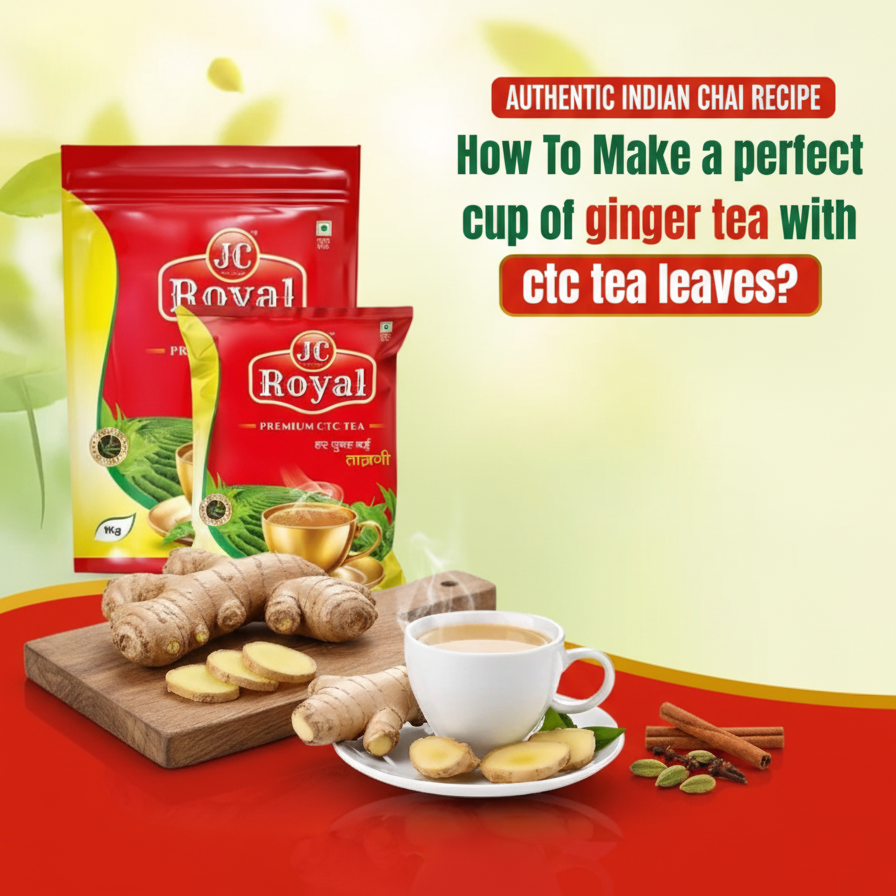
You will need 2 level teaspoons of JC Royal Tea, 1 cup (240 ml) of water, 1 cup (240 ml) of full-fat milk, 2-3 teaspoons of sugar or your preferred sweetener, and a piece of peeled and crushed ginger. You may optionally add 2-3 crushed cardamom pods and 2 whole cloves for an extra masala kick.
Step-by-Step Method
Infuse Spices: Begin by bringing the water and your crushed ginger and/or other whole spices to a rolling boil in a saucepan. Simmer for 1-2 minutes to fully extract the warm, aromatic oils from the spices.
Add Tea & Sugar: Next, add the JC Royal Tea and sugar to this boiling water-spice base. Continue to boil for about 30 seconds. This critical step uses the high heat to quickly and completely release the dark color and full strength of the CTC tea, forming a kadak base.
Introduce Milk: Pour in the milk and bring the entire mixture back up to a boil, stirring occasionally. This cooking process alters the milk’s flavor profile, achieving the traditional creamy, cooked “chai” taste.
The Final Boil: As the chai rises and foams, momentarily reduce the heat, and then return it to a full boil. It is key to repeat this boil-and-subside cycle 2-3 times. This action intensifies and concentrates the flavors, thickens the chai, and ensures maximum color extraction.
Strain & Serve: Finally, turn off the heat and immediately strain the chai into your cups. Straining immediately prevents any further brewing, which would otherwise make the chai overly bitter and astringent.
Darjeeling vs. CTC: The Key Differences in India's Favorite Tea
Both CTC (Crush, Tear, Curl) tea and Darjeeling tea are beloved Indian black teas, but they are unique in their production, flavor profile, and brewing style.
Darjeeling Tea: The ‘Champagne of Teas’
Origin and Climate: Grown in the cool, high-altitude mountain areas of Darjeeling, West Bengal.
Processing: The leaves are gently rolled to maintain their whole-leaf form. This slower process preserves the natural oils.
Plucking: The method is meticulous and time-consuming, involving the hand-picking of only the top two leaves and a bud, which contributes to its premium quality and rarity.
Flavor Profile: Known for a light, musky, spicy flavor and unique floral aroma. It brews to a light golden color.
Brewing: Typically enjoyed lightly brewed without milk or spices to fully appreciate its distinctive, delicate taste.
Harvest: Harvested in specific “flushes” (seasons), such as the First Flush in spring and the Second Flush in summer, which affects its specific flavor characteristics.
CTC Tea: The Everyday Powerhouse
Origin and Climate: Primarily sourced from the warmer plains of Assam, where the abundance of sunlight contributes to its strong flavor.
Processing: Processed using the Crush, Tear, Curl method. The leaves are run through specialized rollers that crush them into small, uniform granules.
Plucking: A quicker process, often done by machines, making it suitable for mass production and ensuring a consistent supply.
Flavor Profile: Delivers a strong, bold, and intense flavor with a deep color and aroma.
Brewing: Perfect for an everyday energy kick. It is traditionally simmered with milk and spices to create popular preparations like Masala Chai.
Harvest: Harvested throughout the year, ensuring a steady and consistent taste for everyday blends.
A Unique Blend: Darjeeling CTC
A special variety, Darjeeling CTC, combines the best of both worlds. It uses the CTC processing method on Darjeeling leaves, resulting in a tea that has the strong, rich taste of CTC but with the delicate aroma of a premium Darjeeling leaf tea.
What Is The Difference Between Darjeeling Leaf Tea And CTC Tea?
Darjeeling leaf tea and CTC tea are both popular types of Indian black teas, each one holding its unique charm. But they do differ in processing, taste, and how they’re enjoyed. Here’s a breakdown of some of the major differences that can easily help you understand it better:
Region And Climate
Darjeeling leaf tea comes from the cool mountain areas of Darjeeling, where the bushes rarely receive sunlight for about 5 hours a day. CTC tea comes from the warmer plains of Assam, where the sun is up for mostly 12 hours a day, and hence the strong flavour. This is also why most CTC tea manufacturers rely on Assam for their bold, strong tea production, while Darjeeling is more popular among the tea companies that focuses on aroma and finesse.
Plucking Method
Darjeeling tea is carefully hand-picked, which usually consists of just the top two leaves and a bud. It’s a more time taking process but results in the best chai patti being sorted.
Plucking CTC tea is a quicker process, mostly done through machines , making it a more practical choice for mass production. This difference makes Darjeeling tea more “rare” amongst many tea producers in India.
Processing Technique
Darjeeling tea goes through gentle rolling so that the leaves remain whole. It preserves the natural oils, keeping the subtle flavour and aroma intact. CTC tea is processed using the Crush, Tear, Curl method, where the leaves are crushed into tea granules, giving a stronger brew and a kick of flavour that can be enjoyed with milk, which is why the best consumer tea brand uses CTC tea in their everyday blends.
Brewing Style And Use
Both of these are kinds of black tea that are brewed and served differently. Darjeeling Tea is brewed lightly to appreciate its flavour. Just hot water and chai patti, and you are done. While CTC is simmered with milk and spices, just as we prepare any Masala Chai , readily available in the market. This makes CTC Tea the best tea in India in terms of the premium flavour it delivers in every serving.
Time Of Harvest
Darjeeling tea is harvested in “flushes” or seasons. The first flush occurs in spring, from early February to mid-April. The second flush happens in peak summers, probably during May-June, and the third one happens during the autumn, during the months of October-November. CTC tea is harvested throughout the year. It doesn’t depend heavily on seasonal flushes, which helps the tea suppliers in India maintain consistent taste year-round.
What Makes Darjeeling CTC Unique?
Darjeeling CTC tea is unique because it brings together the strong and premium taste of CTC (crush-tear-curl) tea and the delicate aroma of freshly picked Darjeeling tea leaves. Normally, Darjeeling teas are light and floral, much like green tea , herbal tea , and ginger tea, but when they are processed with the CTC method, they deliver a strong and rich taste. This unique combination is why many tea lovers and even the best CTC tea brand prefer offering this variety. It’s a great choice if you’re looking for something that’s both aromatic and full-bodied.